

The Shifting Landscape of AI Assistants
A year ago, comparing Gemini to ChatGPT would have been unfair. ChatGPT was clearly superior across most dimensions. But the competitive landscape has shifted dramatically throughout 2026.
Google has made substantial improvements to Gemini's reasoning capability, response quality, and real-time information access. ChatGPT has remained strong but relatively stable. The result: Gemini is now a genuinely competitive alternative rather than a distant second choice.
This comparison examines both tools head-to-head across real-world use cases. The conclusion isn't that one is "better"—it's that they excel in different domains, and your choice depends heavily on your specific needs and existing workflows.
Research and Real-Time Information
This is the dimension where Gemini has the clearest advantage.
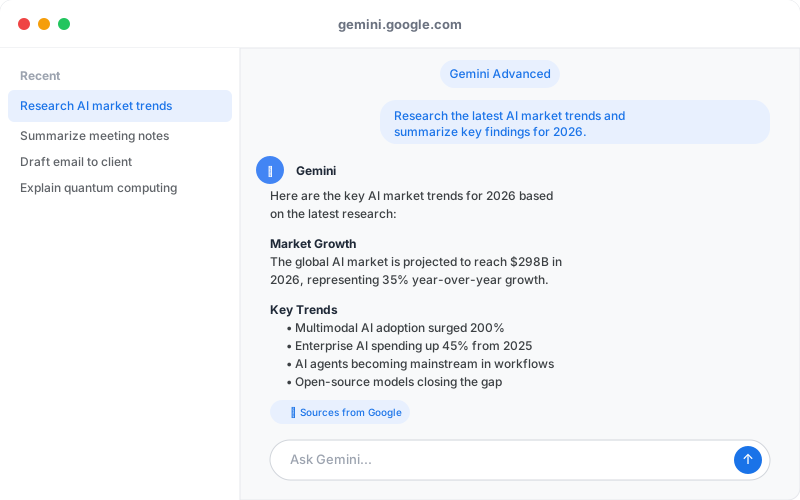
Gemini's native integration with Google Search is exceptional. When you ask Gemini a question requiring current information—recent news, stock prices, newly published research, current weather, emerging events—it returns actual real-time information sourced from Google's search index. The sources are clearly cited, so you can verify and drill deeper.
ChatGPT has web browsing capability, but it requires explicit activation per conversation, and the integration feels less seamless. Additionally, ChatGPT's training data has a knowledge cutoff, so it's fundamentally limited on recent information unless it actively browses.
In our testing, when we asked about recent developments (breaking news from the past week, newly released research from 2026, current market conditions), Gemini was accurate and current. ChatGPT either lacked the information or needed to browse, which added friction.
Verdict: Gemini significantly outperforms for research and current information needs.
Writing Quality and Creative Output
This is more balanced than it was a year ago, but ChatGPT still has a slight edge.
ChatGPT produces more engaging, personality-driven writing. The responses feel conversational and natural. For marketing copy, creative fiction, social media content, or any writing that benefits from voice and personality, ChatGPT remains superior.
Gemini's writing is competent but can feel more formal and verbose. It tends toward longer responses than necessary. When we asked both tools to write a creative product description, ChatGPT's version felt more engaging and punchy. Gemini's was accurate but less compelling.
However, the gap has narrowed. Gemini's creative writing capability has improved markedly. If you're not specifically optimizing for personality, both tools produce acceptable content.
Verdict: ChatGPT edges ahead, but not dramatically.
Coding and Technical Tasks
Both tools are strong at coding, with different strengths.
ChatGPT's Code Interpreter is powerful for data analysis and exploratory programming. You can upload data files, and ChatGPT writes and executes Python code in real-time. For data scientists, this is genuinely valuable. Gemini doesn't have direct code execution capability.
However, for pure code generation and algorithm development, the tools are competitive. In our testing with complex algorithmic problems, both performed well. ChatGPT was marginally better, likely due to more specialized training on coding benchmarks.
Gemini can handle most common coding tasks competently. If your needs are beyond data analysis and exploratory scripts, the difference is negligible.
Verdict: ChatGPT ahead due to Code Interpreter, but Gemini is capable for most coding scenarios.
Document and Multimodal Analysis
Gemini's strength here is its massive context window—up to 1 million tokens, compared to ChatGPT's 128K.
For analyzing long documents, extracting information from complex PDFs, or processing substantial amounts of source material, Gemini's context window is transformative. You can feed Gemini an entire research paper, academic textbook, or lengthy report, and it processes all of it as context for analysis.
ChatGPT's smaller context window means you need to break longer documents into chunks. For many use cases, this isn't a practical limitation, but for serious research or analysis, Gemini's advantage is meaningful.
In our testing with document analysis, Gemini was more reliable at pulling information from complex, lengthy PDFs. It also handles image analysis and visual documents more reliably.
Verdict: Gemini significantly ahead for multimodal and document-heavy work.
Image Generation
Both tools include image generation, but with different quality profiles.
ChatGPT uses DALL-E 3, which tends toward polished, realistic images. The quality is high, and the tool reliably generates usable results.
Gemini uses Google's Imagen, which has improved substantially in 2026. The output quality is now competitive with DALL-E 3, though with a different aesthetic—often more stylized and illustrated rather than photorealistic.
For most practical purposes, both generate images suitable for content creation, presentations, and design work. The choice comes down to aesthetic preference.
Verdict: Nearly equivalent. DALL-E 3 slightly more reliable for photorealism. Imagen better for stylized images.
Google Workspace Integration
This is a decisive factor if you live in Google's ecosystem.
Gemini integrates natively with Gmail, Google Docs, Google Sheets, and Google Drive. You can:
- Summarize emails directly in Gmail
- Generate content in Google Docs with one click
- Analyze data in Google Sheets
- Draft responses to emails
This integration is powerful and reduces friction for workflows centered on Google's tools. ChatGPT offers no comparable native integration (though it works with Google tools via third-party plugins).
If you spend most of your day in Google Workspace, Gemini's integration is genuinely valuable and time-saving.
Verdict: Gemini dramatically ahead for Google Workspace users. ChatGPT offers no native integration.
Ecosystem and Plugins
ChatGPT's plugin ecosystem remains more mature and extensive. You can integrate ChatGPT with hundreds of third-party services: project management tools, CRM systems, marketing automation, code repositories, analytics tools, and more.
Gemini's integration ecosystem is smaller. It works well with Google's services but lacks the extensive third-party connections ChatGPT has.
If you need to integrate AI into complex workflows involving non-Google tools, ChatGPT's ecosystem is more mature and flexible.
Verdict: ChatGPT substantially ahead.
Speed and Responsiveness
Both tools are fast. In our testing, response times were comparable, with neither consistently faster than the other. You won't notice a meaningful speed difference in practice.
Verdict: Equivalent.
Privacy Considerations
This is nuanced and worth examining.
Google's Gemini raises privacy concerns due to Google's broader data collection practices. Google has access to your search history, location data, email, calendar, and more. Using Gemini means you're feeding AI interactions into Google's broader data apparatus.
OpenAI's ChatGPT has separate privacy policies, and while data is collected, it's arguably more compartmentalized from broader surveillance infrastructure.
However, neither tool is ideal from a privacy perspective. Both collect usage data. Both train on interactions (though both have opt-out options).
If privacy is your primary concern, consider local alternatives like Claude or open-source models you run yourself.
Verdict: Slight edge to ChatGPT for privacy separation, but both have legitimate concerns.
Pricing and Value Proposition
Both charge $20/month for their paid tiers (ChatGPT Plus and Gemini Advanced). Both have generous free tiers.
The value proposition differs based on your usage:
- Google Workspace users: Gemini is better value due to integration benefits
- Code-heavy workflows: ChatGPT is better value due to Code Interpreter
- Research workflows: Gemini is better value due to real-time web access and context window
- Diverse creative work: ChatGPT is better value due to plugin ecosystem
At pricing parity, the choice comes down to feature fit rather than cost.
Verdict: Equivalent pricing, different value depending on use case.
Who Should Choose Gemini?
- Google Workspace users who want seamless integration with email, docs, and sheets
- Researchers who need real-time, sourced information
- People analyzing complex documents who benefit from 1M token context window
- Users living in Google's ecosystem (Android, Google Assistant replacement)
- Anyone concerned about OpenAI dominance wanting a Google alternative
- People preferring stylized image generation over photorealism
Who Should Choose ChatGPT?
- Coders and data scientists who need Code Interpreter
- People who value personality and voice in AI-generated writing
- Teams using diverse third-party tools needing plugin integrations
- Content creators who want creative, engaging outputs
- Anyone wanting the most mature, stable AI assistant
- Users prioritizing plugin ecosystem and tool integration
- People with complex workflows requiring extensive integrations
The Honest Verdict
ChatGPT remains the more versatile, more integrated, more stable choice for general-purpose AI assistance. It's the default that works well for most people and most use cases.
But Gemini is no longer a distant alternative. It's genuinely competitive, and for specific use cases—Google Workspace users, researchers, document analysis—it's the better choice.
The competitive landscape of AI assistants is healthier than ever. Google's Gemini improvements throughout 2026 have forced OpenAI to remain sharp. Both tools have improved. Users benefit from genuine competition.
Your choice should be based on specific needs, not general reputation. Google Workspace user? Gemini. Need Code Interpreter? ChatGPT. Both are excellent choices, and the days of ChatGPT being clearly superior are behind us.
Related Reading
- How does Claude compare? Read our in-depth Claude vs ChatGPT comparison.
- Microsoft's AI offering: See how Copilot compares to ChatGPT.
- The budget option: Check out DeepSeek vs ChatGPT for a free alternative.
- New to ChatGPT? Our beginner's guide to ChatGPT covers everything you need.
- Exploring alternatives? See our best ChatGPT alternatives ranked and reviewed.
- Need AI for writing? Browse our best AI writing tools roundup.