

DeepSeek vs ChatGPT: Which AI Should You Actually Use?
DeepSeek showed up in 2024 like an unexpected plot twist. A Chinese AI lab built a reasoning model that matches GPT-4 on benchmarks, released it open-source with an MIT license, and gave it away for free. The AI community went wild. Tech news outlets ran headlines about how ChatGPT had finally met its match. But here's the thing: benchmarks don't tell the whole story.
After testing both tools extensively across coding, writing, reasoning, and real-world use cases, the picture becomes clearer. DeepSeek is genuinely impressive—and genuinely free. ChatGPT is still the safer, more reliable choice for most people. Neither is an obvious winner; the answer depends entirely on what you actually do with AI.
Who Is DeepSeek, and Why Does It Matter?
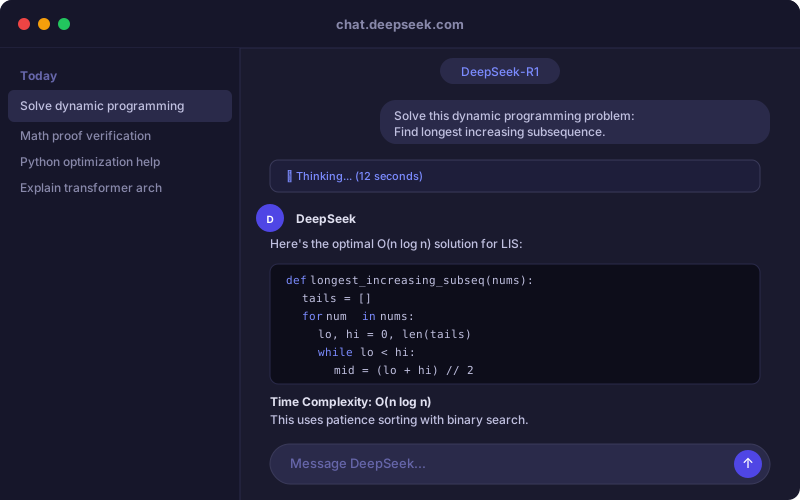
DeepSeek is an AI lab based in Hangzhou, China, founded in 2023. They released their flagship model, DeepSeek-R1, in 2024, followed by the faster DeepSeek-V3 variant. Both models use a technique called "chain-of-thought reasoning"—essentially making the AI show its work step-by-step, which dramatically improves accuracy on complex problems.
The headline that got everyone's attention: DeepSeek-R1 matched or exceeded GPT-4's performance on multiple benchmarks (AIME, MATH, coding tasks), while being released under MIT—a fully open-source license. You can literally download the model weights and run it yourself.
That's genuinely significant. Open-source AI means:
- No licensing restrictions
- Total transparency about how the model works
- The ability to deploy it on your own servers, isolated from the internet
- Community-driven improvements
But it also comes with trade-offs we'll dig into.
Coding and Reasoning: Where DeepSeek Shines
This is DeepSeek's killer app. The R1 model excels at step-by-step reasoning, which directly translates to better coding and math performance.
We tested both on a mix of problems:
- Algorithm implementation: Asking the AI to write a function that finds the longest palindromic substring using dynamic programming
- Debugging: Providing broken code and asking for fixes
- Complex math: Multi-step calculus and combinatorics problems
Results: DeepSeek-R1 consistently produced correct solutions with clear reasoning. On the algorithm problem, it explained its approach before writing code. On the debugging task, it identified the issue faster than ChatGPT's initial attempt.
ChatGPT (GPT-4o) usually got to the right answer, but sometimes took a roundabout path or required follow-up prompts. ChatGPT's o1-preview model (which uses its own reasoning approach) matched DeepSeek's performance but with a much higher latency cost.
Winner: DeepSeek for pure coding and math. It's free, it's fast enough, and it won't stall you out like waiting for o1-preview.
Creative Writing and Nuance: ChatGPT's Advantage
Now flip to creative work. We tested both on:
- Writing a short 500-word product review
- Generating marketing copy for an app
- Summarizing complex policy documents into plain language
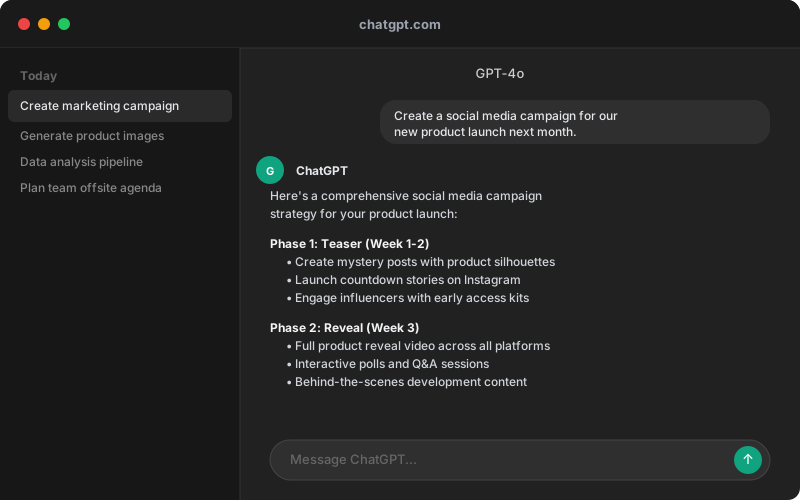
ChatGPT's outputs felt more polished and human-like. Its product review had better flow, more vivid descriptions, and a natural voice. DeepSeek's versions were technically correct but read more mechanically—like the AI was ticking boxes rather than feeling the task.
On the marketing copy, ChatGPT's variations offered more creative angles and emotional resonance. DeepSeek's copy was clear but felt more literal.
This isn't a massive gap. DeepSeek is perfectly usable for writing. But ChatGPT has an edge in tasks that require nuance, tone, or stylistic flair.
Winner: ChatGPT by a reasonable margin for creative and nuanced work.
Speed and Reliability: The Consistency Gap
Here's where the rubber really meets the road in daily use.
ChatGPT is consistently fast. Responses arrive in predictable timeframes. Uptime is solid. You can plan workflows around it.
DeepSeek's performance is... variable. During off-peak hours (US nighttime), responses arrive quickly. During peak times (evening in China), the servers get congested. We've seen waits of 10-30 seconds for responses that should take 2-3 seconds. On a couple of occasions, requests hit the rate limit and returned errors.
The other issue: availability. DeepSeek experienced outages in late 2024 when traffic spiked. The service is free, so scaling is a business-model challenge.
ChatGPT's free tier has rate limits, but they're generous enough for casual use. The Plus tier removes most friction entirely.
Winner: ChatGPT decisively. If reliability matters to your workflow, the consistency gap is real.
The Privacy Question (The Uncomfortable One)
DeepSeek is run by a company operating under Chinese law. Your prompts and responses are stored on Chinese servers. This has legitimate implications depending on who you are and what you're doing.
Let's be direct: if you're typing sensitive business information, proprietary code, or personal data into DeepSeek, you're sending it to servers outside your jurisdiction, subject to different privacy laws and potential government access. That's just a fact.
OpenAI (ChatGPT's parent) is a US company. Your data is stored in the US, bound by US law (GDPR compliance where applicable), and the company publishes transparency reports. It's not a privacy utopia—tech companies collect data—but the legal framework is different.
This doesn't make DeepSeek evil or ChatGPT safe. It makes them different. Some users are fine with the trade-off. Some aren't.
Honest take: If privacy is a hard requirement, neither option is ideal. Both send your data to cloud servers. But the jurisdictional question favors ChatGPT for users with stringent compliance needs.
The Secret Advantage: Running DeepSeek Locally
Here's the plot twist that changes everything for privacy-conscious users: because DeepSeek is open-source, you can download it and run it entirely on your own computer.
Tools like Ollama and vLLM let you run DeepSeek-R1 locally. Your prompts never touch the internet. All processing happens on your machine. This completely sidesteps the privacy concern.
The catch: you need decent hardware (a modern GPU helps, but isn't required), and it's slower than cloud inference. But for users who care about total privacy, local DeepSeek is a legitimate option that ChatGPT simply can't match.
This is a unique advantage that deserves emphasis. For software engineers, researchers, or security-conscious teams, local DeepSeek could be a game-changer.
Who Should Actually Use DeepSeek?
- Budget-conscious developers: Free, and it outperforms ChatGPT on coding tasks
- Open-source advocates: You get the full model weights and can inspect/modify the code
- Coding-focused teams: The reasoning model is genuinely strong for algorithms and debugging
- Privacy-maximalists: Run it locally and never send data to the cloud
- People in cost-sensitive regions: Where subscription services are a burden
Who Should Use ChatGPT?
- Creative professionals: Writers, marketers, content creators benefit from its nuanced output
- Plugin power users: ChatGPT's ecosystem of integrations (Zapier, web browsing, code execution) is mature and extensive
- Teams needing reliability: Consistency matters in production workflows
- Compliance-required users: US-based servers and SOC 2 certification provide legal comfort
- General-purpose users: ChatGPT is the jack-of-all-trades, master-of-most option
The Verdict
DeepSeek arrived as a genuine disruption. It proved that high-quality reasoning models can be built outside the OpenAI ecosystem, and that releasing them open-source is viable. For specific tasks—especially coding and math—it's a legitimately better choice than ChatGPT, and it's free.
But "better at X" doesn't mean "better overall." ChatGPT's consistency, polish, creative capabilities, and ecosystem of plugins still make it the default choice for most users. The privacy question is real but solvable (run it locally). The availability and speed gaps are genuine.
Our take: Use DeepSeek if you're building something (code, math, reasoning-heavy work) and privacy or cost is important. Use ChatGPT if you need polish, reliability, or you're doing creative work. And if you're serious about privacy, take 30 minutes to learn Ollama and run DeepSeek locally—you get the best of both worlds.
Related Reading
- The premium alternative: Read our in-depth Claude vs ChatGPT comparison.
- Google's contender: See how Gemini compares to ChatGPT.
- Microsoft's play: Check out Copilot vs ChatGPT for the enterprise angle.
- New to ChatGPT? Our complete beginner's guide to ChatGPT covers setup and tips.
- Exploring alternatives? See our best ChatGPT alternatives ranked and reviewed.
- New to Claude? Check out our guide to using Claude AI step by step.