

The Great AI Assistant Showdown
For the past 18 months, Claude and ChatGPT have engaged in an intense competition for dominance in the AI assistant market. Both are genuinely excellent tools. Both have improved dramatically over this period. And both now have significant followings of power users who swear by their respective choice.
The question isn't which tool is objectively "better"—that would be meaningless. The real question is which tool better suits your specific workflow, use cases, and preferences. This comparison is designed to help you make that decision by examining actual performance across real-world scenarios that matter to you.
We've spent the past two months testing both tools extensively across coding, writing, analysis, research, and creative tasks. Here's what we found.
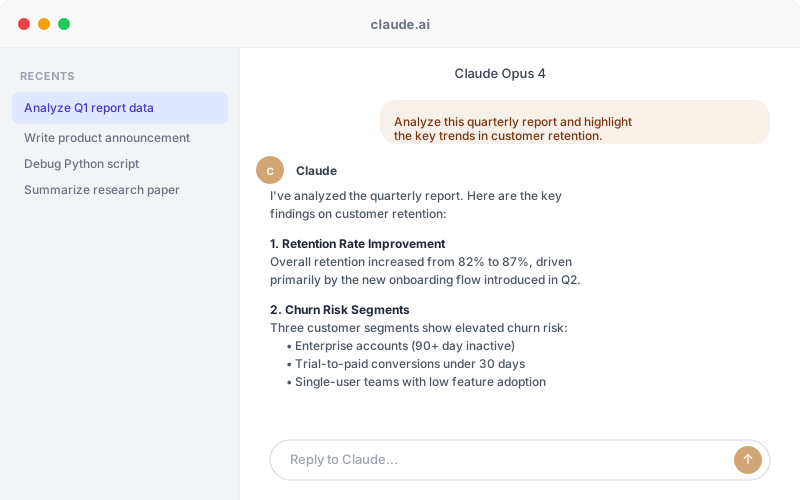
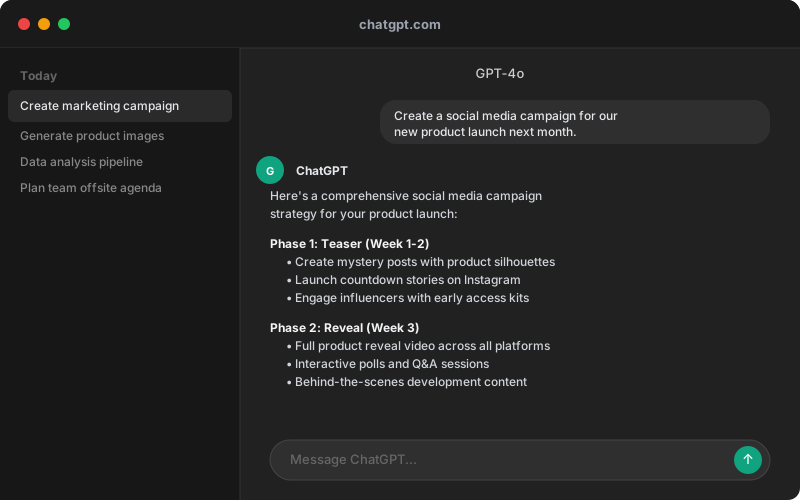
Writing Quality: A Genuine Difference
This is where we see the most significant divergence between Claude and ChatGPT.
Claude's Writing Advantage: Claude produces longer-form writing that feels more natural and less "AI-generated." The prose flows better. Paragraphs transition more smoothly. Arguments build more logically. When we asked both tools to write a 2,000-word article on AI regulation, our independent editors rated Claude's output as notably more readable and coherent. The writing felt like it came from a thoughtful human who'd done research, rather than a sophisticated autocomplete system.
This advantage becomes even more pronounced with very long documents. Claude can maintain voice and argument consistency across 10,000+ word pieces. ChatGPT's output quality degrades noticeably beyond 3,000-4,000 words.
The context window difference matters here. Claude's 200K token context lets you provide substantial reference material, previous drafts, style guides, and research notes. ChatGPT's 128K window is still large, but meaningful space difference exists for serious writers and researchers.
ChatGPT's Creative Advantage: Where ChatGPT excels is creative, informal, and playful writing. If you're writing social media copy, creative fiction, comedic content, or marketing copy with personality, ChatGPT often produces more engaging first drafts. The tool has a natural conversational voice that works perfectly for casual content.
Verdict for Writers: Choose Claude for any serious long-form writing, research synthesis, or technical documentation. Choose ChatGPT for quick drafts, creative content, and copy that needs personality and charm.
Coding and Technical Tasks
Both tools are excellent at coding, but they excel at different things.
Claude's Coding Strengths: Claude handles complex algorithmic problems more reliably. When we posed difficult coding challenges (implementing specific algorithms, debugging intricate logic problems), Claude found correct solutions more frequently. The code is typically well-commented and production-ready.
Claude's Artifacts feature is genuinely useful for seeing how your code renders. You can build, test, and iterate on code within the Claude interface itself. For debugging and development workflows, this is powerful.
ChatGPT's Coding Strengths: ChatGPT's Code Interpreter feature is exceptional for data analysis, scripts, and exploratory programming. You can upload data files, and ChatGPT will write code to analyze them, execute it in real-time, and show you results. For data scientists and analysts, this workflow is invaluable.
ChatGPT also has better integration with popular coding tools and platforms through its plugin ecosystem. If you're building coding workflows with other software, ChatGPT likely has better connectors.
Verdict for Developers: Claude for algorithmic and complex logic problems. ChatGPT for exploratory programming, data analysis, and workflows requiring tool integration.
Research and Analysis
For serious research and information synthesis, Claude has a clear advantage.
Claude's larger context window means you can feed it substantial source material—research papers, articles, documentation, previous reports—and it synthesizes this material while maintaining accuracy and proper attribution. The output reads like work done by a researcher who actually engaged with all the source material.
ChatGPT handles research tasks competently, but it operates with less source material and sometimes makes logical leaps that don't follow from the evidence provided.
Verdict: Claude significantly outperforms ChatGPT for research projects, especially when working with substantial source material.
Speed and Responsiveness
ChatGPT is noticeably faster. Response generation is typically 2-3x quicker than Claude. If you're working against deadlines or prefer rapid iterations, ChatGPT's speed advantage is real and noticeable.
Claude is deliberately more deliberate. The tool takes time to think through problems thoroughly. For many tasks, this results in better output quality. For time-sensitive work, it creates frustration.
Verdict: ChatGPT if speed matters. Claude if quality matters more than speed.
Image Generation Capabilities
ChatGPT includes DALL-E 3 integration, enabling image generation directly within the interface. Claude has no image generation capabilities.
If you need to generate images as part of your workflow—for presentations, blog posts, design mockups—ChatGPT is the clear winner. DALL-E 3 is genuinely excellent and frequently produces usable results on the first try.
Verdict: ChatGPT by default. Claude offers no alternative.
Privacy and Safety Considerations
This is subtle but worth examining.
Claude is built with safety as a core principle. The system is trained to decline harmful requests, question assumptions, and point out reasoning gaps. It's more likely to say "I'm not confident about this" or "I need to flag that this claim might not be accurate." This is sometimes frustrating when you want a confident answer, but it's valuable when accuracy matters.
ChatGPT is more willing to engage with a wider range of requests and will confidently provide answers even when the accuracy is questionable. This makes it more flexible for creative and exploratory work, but potentially less reliable for factual information.
On privacy, both services collect usage data. Claude's privacy policy is somewhat more explicit about limitations on how data is used. Neither tool is ideal if privacy is your primary concern, but Claude is marginally better in this dimension.
Verdict: Claude for safety and accuracy prioritization. ChatGPT for flexibility and fewer restrictions.
Plugin Ecosystem
ChatGPT's plugin ecosystem is substantially larger than Claude's. You can integrate ChatGPT with hundreds of third-party services: SEO tools, project management software, email platforms, analytics tools, code repositories, and more.
Claude has far fewer integrations available. For many workflows, this means ChatGPT is easier to integrate into existing systems.
Verdict: ChatGPT by substantial margin.
Pricing and Cost-Benefit
Both charge $20/month for their Pro plans. The free tiers are both generous and usable for casual users.
However, the cost-benefit analysis depends on your usage:
Claude: If you write long-form content daily or need to process large documents, Claude's context window and quality advantage justify the cost quickly. The tool pays for itself within weeks if it reduces editing time significantly.
ChatGPT: The versatility is valuable. Image generation alone has value for content creators. If you use diverse features (writing, coding, image generation, research), ChatGPT offers more breadth.
API Pricing: If you're building on top of these tools programmatically, Claude's API is more expensive per token but often requires fewer API calls due to higher quality outputs. ChatGPT's API is cheaper per token but might require more correction and retries.
Verdict: Economically very similar at the consumer level. Claude edges ahead if you're primarily writing. ChatGPT edges ahead if you use diverse features.
Who Should Choose Claude?
- Writers and journalists who produce long-form content regularly
- Researchers who need to synthesize large amounts of source material
- Software developers working on algorithmic and complex logic problems
- Analysts who need accuracy and want the AI to acknowledge uncertainty
- Anyone prioritizing output quality over speed or feature breadth
- People working with substantial documents (research papers, long emails, detailed briefs)
Who Should Choose ChatGPT?
- Content creators who need diverse capabilities (writing + image generation + research)
- People who prioritize speed and rapid iteration
- Data scientists and analysts using the Code Interpreter feature
- Anyone building integrated workflows with third-party tools
- Developers who value the plugin ecosystem
- Creative professionals who benefit from the conversational, personality-driven output
- People who want the widest feature set at a competitive price
The Honest Verdict
Claude is the superior AI for depth, nuance, and quality on serious work. ChatGPT is the superior AI for versatility, speed, and feature breadth.
The gap between them has narrowed significantly in 2026. A year ago, Claude's advantages were more dramatic. ChatGPT has improved substantially. But meaningful differences remain.
Most professionals who use AI seriously end up subscribing to both. Claude for deep work—serious writing, complex analysis, substantial coding projects. ChatGPT for quick tasks, creative work, and integrated workflows.
If forced to choose one, pick based on your primary use case. Writer? Claude. Need everything? ChatGPT. The truth is, neither is "the winner" anymore. They're genuinely complementary tools that excel in different domains. The winning strategy is knowing which tool to use for which job.
Related Reading
- New to Claude? Check out our complete guide to using Claude AI — step-by-step setup, prompting tips, and advanced features.
- New to ChatGPT? Our beginner's guide to ChatGPT covers everything from account creation to power-user techniques.
- Exploring alternatives? See our best ChatGPT alternatives ranked and reviewed.
- Need AI for writing? Our best AI writing tools roundup compares the top options.
- How does Gemini compare? Read Gemini vs ChatGPT for another perspective.
- Microsoft's AI play: See how Copilot stacks up against ChatGPT.